

Tuesday, October 21, 2008
Ozone Depletion
Man-made chemicals have damaged the ozone layer that protects the earth from ultra violet (UV) radiation. We have phased out many ozone destroying chemicals but we’re still unsure how and when the ozone layer will recover.
What is ozone?
Ozone is a gas made of oxygen atoms. It can be found at ground level where it is a pollutant and a health hazard. But the useful ozone in the upper atmosphere, known as the ozone layer, is being destroyed. Here, ozone absorbs some of the potentially harmful ultraviolet radiation from the sun.
Which chemicals damage the ozone layer?
A group of chemicals known as halocarbons destroy ozone. The most familiar of these are chlorofluorocarbons (CFCs).
Aerosols and old refrigerators have released CFCs into the atmosphere. UV radiation breaks down CFCs in the upper stratosphere, releasing chlorine. Once released, chlorine becomes a catalyst of ozone destruction. A catalyst is something that makes a chemical reaction happen more easily, but it remains unchanged or reforms by the end of the reaction. It can then take part in the reaction again.
During this process, the ozone molecule is destroyed while the chlorine catalyst reforms. A single chlorine atom in the stratosphere can destroy about 100,000 ozone molecules.
The chemicals released into the upper atmosphere destroy ozone. However, pollution at ground level creates ozone, which can also affect life
How much of the ozone layer has been damaged?
In the past 30 years the ozone holes over the north and south poles have grown and shrunk.It was first suggested in 1974 that CFCs might damage the ozone layer. Scientists discovered a hole in the ozone layer over Antarctica in 1985. In September 2000, the ozone hole reached a record size of 30 million km2 - larger than North America. In September 2002, the ozone hole was just 15 million km2 - the smallest it has been since 1988.
Does the ozone layer damage affect the UK?
Yes. Ozone layer damage extends from the Arctic to northern Europe, including the UK. At Camborne in Cornwall and Lerwick in the Shetland Islands, total ozone concentrations have generally fallen since 1979 (suggesting ozone loss), although there has been an increase in recent years (Figure 1).
What are the effects of ozone loss?Declining ozone values mean UV levels have increased over the UK. UV exposure stops our immune systems working properly. We can develop eye cataracts and skin cancers. Deaths in England and Wales from malignant skin melanomas rose from 200 to 300 per year in the early 1950s to to 2167 in 2008.
UV radiation may also damage plants, and the young stages of aquatic wildlife.
What is being done to stop ozone layer damage? Industrialised countries have agreed to phase out halocarbons. Some critical uses are exempt and developing countries have been given longer time-scales. The UK did not stop CFC production until 2000.
By the late 1990s, atmospheric concentrations of other halocarbons had levelled out. Bromine concentrations should peak between 2000 and 2010, but will decline only slowly because a high proportion comes from uncontrolled sources, including the oceans.
HCFC (hydrochlorofluorocarbons) concentrations have increased from the early 1990s because they are used as a substitute for CFCs. Globally, HCFCs must be cut by 99.5% by 2020. They should begin to decline after 2010 as they are phased out. HCFCs will be banned in the European Union from 2015.
Stockpiled, recycled and illegally traded CFCs, together with those in refrigeration and fire-fighting equipment, will still be around for many years. The EU has regulations to prevent leaks of ozone depleting substances and promote recovery after use in industrial processes, although not in manufactured products.
Will ozone levels ever return to normal?
We don’t expect to see the signs of recovery in the ozone layer for 15 to 20 years. If the provisions of the Montreal Protocol on Substances that Deplete the Ozone Layer of 1987 are strengthened and followed, there is a prospect that the Antarctic ozone hole will be repaired by 2100. But greenhouse gases and changing global temperatures which are also altering the atmosphere make the nature of recovery uncertain. However, if the provisions of the Montreal Protocol are strengthened and followed, we could see the Antarctic ozone hole repaired by 2100.


Sunday, October 19, 2008

Destabilization of local climates
In the northern hemisphere, the southern part of the Arctic region (home to 4,000,000 people) has experienced a temperature rise of 1 °C to 3 °C (1.8 °F to 5.4 °F) over the last 50 years. Canada, Alaska and Russia are experiencing initial melting of permafrost. This may disrupt ecosystems and by increasing bacterial activity in the soil lead to these areas becoming carbon sources instead of carbon sinks . A study (published in Science) of changes to eastern Siberia's permafrost suggests that it is gradually disappearing in the southern regions, leading to the loss of nearly 11% of Siberia's nearly 11,000 lakes since 1971 . At the same time, western Siberia is at the initial stage where melting permafrost is creating new lakes, which will eventually start disappearing as in the east. Furthermore, permafrost melting will eventually cause methane release from melting permafrost peat bogs.
Hurricanes were thought to be an entirely North Atlantic phenomenon. In late March 2004, the first Atlantic cyclone to form south of the equator hit Brazil with 40 m/s (144 km/h) winds, although some Brazilian meteorologists deny that it was a hurricane.Monitoring systems may have to be extended 1,600 km (1,000 miles) further south. There is no agreement as to whether this hurricane is linked to climate change, but one climate model exhibits increased tropical cyclone genesis in the South Atlantic under global warming by the end of the 21st century.
Hurricanes were thought to be an entirely North Atlantic phenomenon. In late March 2004, the first Atlantic cyclone to form south of the equator hit Brazil with 40 m/s (144 km/h) winds, although some Brazilian meteorologists deny that it was a hurricane.Monitoring systems may have to be extended 1,600 km (1,000 miles) further south. There is no agreement as to whether this hurricane is linked to climate change, but one climate model exhibits increased tropical cyclone genesis in the South Atlantic under global warming by the end of the 21st century.
Wednesday, October 1, 2008
Polar Bears....soon a thing of the past
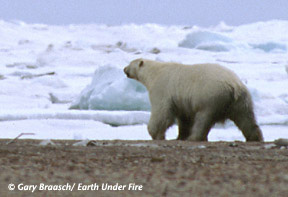
Polar Bear Listed in Endangered Species Act, but U.S. Government Limits Its Protection
The polar bear was officially listed as threatened under the U.S. endangered species act (ESA) on May 14, 2008. This the first creature brought under the act's protection for habitat loss that is linked to global warming. The official reason given was loss of Arctic sea ice and predictions that the ice will continue to decrease. Although global warming has been identified by most atmospheric and polar scientists as the main reason for Arctic warming and melting of sea ice, the U.S. Interior Department did not use this as a reason and clearly signaled it would not apply the law to greenhouse gas emissions.
Dirk Kempthorne, Interior Secretary, specifically said the listing would not prevent any sea ice from melting and that he would "make certain the ESA isn't abused to make global warming policies." This despite clear language in the ESA to control any activity causing harm to a listed species and requiring government agencies specifically not to jeopardize species by their actions. The wording of the listing document appears to be an attempt of the government to list the bear due to clear evidence of shrinking habitat yet not take all the steps to limit the loss. It seems analogous to President Bush's notorious "signing statements" limiting his acceptance of a Congressional law.
This could set up another court challenge by NGOs like the Center for Biological Diversity which originally brought the proposal and took the Interior Dept to court twice to get action.
"Threatened" under the ESA means a plant or animal may soon become endangered (at immediate risk of going extinct) if actions are not taken to protect it and its habitat.
Global Warming......Save us oh Mighty Lord

Global warming is the increase in the average measured temperature of the Earth's near-surface air and oceans since the mid-20th century, and its projected continuation.
The average global air temperature near the Earth's surface increased 0.74 ± 0.18 °C (1.33 ± 0.32 °F) during the 100 years ending in 2005. The Intergovernmental Panel on Climate Change (IPCC) concludes "most of the observed increase in globally averaged temperatures since the mid-twentieth century is very likely due to the observed increase in anthropogenic (man-made) greenhouse gas concentrations"via an enhanced greenhouse effect. Natural phenomena such as solar variation combined with volcanoes probably had a small warming effect from pre-industrial times to 1950 and a small cooling effect from 1950 onward.
These basic conclusions have been endorsed by at least 30 scientific societies and academies of science,including all of the national academies of science of the major industrialized countries.While individual scientists have voiced disagreement with some findings of the IPCC, the overwhelming majority of scientists working on climate change agree with the IPCC's main conclusions.
Climate model projections summarized by the IPCC indicate that average global surface temperature will likely rise a further 1.1 to 6.4 °C (2.0 to 11.5 °F) during the twenty-first century.This range of values results from the use of differing scenarios of future greenhouse gas emissions as well as models with differing climate sensitivity. Although most studies focus on the period up to 2100, warming and sea level rise are expected to continue for more than a thousand years even if greenhouse gas levels are stabilized. The delay in reaching equilibrium is a result of the large heat capacity of the oceans.
Increasing global temperature is expected to cause sea levels to rise, an increase in the intensity of extreme weather events, and significant changes to the amount and pattern of precipitation, likely leading to an expanse of tropical areas and increased pace of desertification. Other expected effects of global warming include changes in agricultural yields, modifications of trade routes, glacier retreat, mass species extinctions and increases in the ranges of disease vectors.
Remaining scientific uncertainties include the amount of warming expected in the future, and how warming and related changes will vary from region to region around the globe. Most national governments have signed and ratified the Kyoto Protocol aimed at reducing greenhouse gas emissions, but there is ongoing political and public debate worldwide regarding what, if any, action should be taken to reduce or reverse future warming or to adapt to its expected consequences.
The average global air temperature near the Earth's surface increased 0.74 ± 0.18 °C (1.33 ± 0.32 °F) during the 100 years ending in 2005. The Intergovernmental Panel on Climate Change (IPCC) concludes "most of the observed increase in globally averaged temperatures since the mid-twentieth century is very likely due to the observed increase in anthropogenic (man-made) greenhouse gas concentrations"via an enhanced greenhouse effect. Natural phenomena such as solar variation combined with volcanoes probably had a small warming effect from pre-industrial times to 1950 and a small cooling effect from 1950 onward.
These basic conclusions have been endorsed by at least 30 scientific societies and academies of science,including all of the national academies of science of the major industrialized countries.While individual scientists have voiced disagreement with some findings of the IPCC, the overwhelming majority of scientists working on climate change agree with the IPCC's main conclusions.
Climate model projections summarized by the IPCC indicate that average global surface temperature will likely rise a further 1.1 to 6.4 °C (2.0 to 11.5 °F) during the twenty-first century.This range of values results from the use of differing scenarios of future greenhouse gas emissions as well as models with differing climate sensitivity. Although most studies focus on the period up to 2100, warming and sea level rise are expected to continue for more than a thousand years even if greenhouse gas levels are stabilized. The delay in reaching equilibrium is a result of the large heat capacity of the oceans.
Increasing global temperature is expected to cause sea levels to rise, an increase in the intensity of extreme weather events, and significant changes to the amount and pattern of precipitation, likely leading to an expanse of tropical areas and increased pace of desertification. Other expected effects of global warming include changes in agricultural yields, modifications of trade routes, glacier retreat, mass species extinctions and increases in the ranges of disease vectors.
Remaining scientific uncertainties include the amount of warming expected in the future, and how warming and related changes will vary from region to region around the globe. Most national governments have signed and ratified the Kyoto Protocol aimed at reducing greenhouse gas emissions, but there is ongoing political and public debate worldwide regarding what, if any, action should be taken to reduce or reverse future warming or to adapt to its expected consequences.
Subscribe to:
Posts (Atom)


